What makes ROUTINE scary?
The scary components of ROUTINE come out in its environment, and it’s ability to make you feel like there things lurking. It’s the constant expectation of something in the dark, combined with a hyper-realistic environment that laws and rules which the other elements of the world must abide by. For example, even in the first area of the game, there is a long dark hallway which you cannot see down. It’s opposing the window looking out on to the surface of the moon. The contrast of this is really stark, and I can’t find a name for it online so I’m just going to name it the “Abyss Effect” after the classic Nietzsche quote “Stare into the abyss and the abyss stares back into to you.”
The game also features several sections in which you have to engage with terminals, most of which follow a few consistent rules:
- It is never clear if you are safe while using them,
- Things behind you are wide open,
- Terminals are clunky and difficult to use. The second rule here is what makes using the terminals feel so uncomfortable. It is the feeling that, behind your back, the world looms. A wide open space in which you are NOT safe. Even if the player cannot be killed or “gotten” by the monster, which is usually the case, the general feeling of using a terminal is exemplified by this sensation of an open-back. That you need to focus now, and engage with something clunky and complex, all the while there could be something behind you. This is doubly reinforced by the long thin hallways leading to the door terminals in Chapter 05, which consistently make you have this “Open Back” effect.
Additionally, they promote a feeling of Unsafety throughout the game, even in sections where it would be detrimental to the design if you were truly unsafe. Routine works because the puzzles are hard, and you have to think while you are terrified. The feeling of being unsafe and having to solve a problem is what makes a horror game, and Routine specifically, very very good. I’ll describe this as the Puzzle-In-Crisis, joined with the Feeling of Unsafety and discuss how the puzzles are playful out of context, and stressful in context.
The same effect as a “Puzzle-In-Crisis” can be found in the narrative as you attempt to unravel the mystery. Because the story is told out of order, you must piece together the components of it while working against the creature and the world. The result of this is a far more interesting and mysterious component of the game. It works in the game’s favor, and helps to both reinforce the pillars of hyper-realism, atmosphere, and the uncanny valley (unreliable narrators make everything almost make sense).
One of the strengths of the game’s fictional elements is its ability to present science-fictional elements through the lens of a set of rules. There is never a point in the game where you encounter a system and think “that’s inconsistent” compared to what you know. This is incredibly important to the logic of the game world. It upholds the pillars of Hyper-Realism and is supported by the sound design, and logic of the monsters. This could be seen as a Hard Sci-Fi component, which supports the game tremendously, and is conjoined with elements of the Environmental Art, Sound Design, and even the Logic of the Terminals.
The game also features a tremendously strong [[Frog Boiling Effect]], which slowly brings you through the beginning of the game with the bots, and ends with you encountering Adam. The environmental lighting throughout the game is also designed to make you feel as if you are moving to a scarier section. Comparing the sewage systems to the mall, it is clear that the meanings and uses of color are dramatically different. Resulting in a far more intense reaction from the player, as they begin to encounter The Unknown more and more through both small and large effects.
I’ll organize my thoughts by category here and continue to define them as I think them through. I’ll section each idea, theory, or effect and reference different points of the game to showcase them as examples, and why they work.
Abyss Effect
Describing the Abyss Effect
I’ve named this effect after the Nietzsche quote “Stare into the abyss, and the abyss will stare back.” It focuses on exemplifying the unknown of a space, focusing on the feeling of contrast between what is and is not known, and how we are part of something much larger than we realize. The Abyss Effect is leveraged throughout ROUTINE, and used pretty liberally to get the specific feeling it’s looking for.
First Area’s Abyss
Right after you wake up, you’re given a large hallway with a lit end and a dark end. Both of these feature different kinds of Abyssal feelings. The light end shows the surface of the moon, and the vast emptiness of space. It gives you a grand set piece showing off the scale of the game. The other end is a seemingly endless dark hallway, that you can never see the end of. In reality, there is nothing there. Even so, the hallway’s darkness and length create a dramatic sense of scale, and an openness to the environment which suggests it is far larger than you expected.
Abyss on Train Platform
The endless lengths of the train platform draw your eye when you go there for the first time, and become even more prevalent when the IC bot at the mall lets you walk along them for a brief period before taking the ladder to the mall. It’s a gaping maw that makes the space feel large and deep, but not hollow.
Abyss in the Ward
The Ward is filled with dramatic abysses. It has several hallways in completely shrouded darkness, focusing on the concept of indiscernible distance. Staring down a hallway and not being able to see the end is a fantastic way to present the Abyss as a threat. This is used constantly, in the game as a method of building atmosphere and presenting the unknown. It works doubly well in the ward, as Adam begins lurking. Every dark corner is no longer a hypothetical abyss, and is now a real potential threat.
Open-Back Effect
Describing the Open Back Effect
Throughout the game there is a consistently used effect which I can only describe as the Open Back Effect. To put it bluntly, it is whenever the player is forced to be in a scenario where they must face in one direction, and behind them there is a large open space. Thus, their back is exposed, and open to the world. This is used throughout Routine to exemplify the feeling of vulnerability. Entire environments and puzzles are designed with this in mind. It’s never used as a one-off either. The Open Back Effect is a constant in Routine.
This effect relates heavily to the section on the False Sense of Unsafety.
In Relation to Terminals
The first time this effect is encountered is when you have to interact with terminals in the first half of the game. The Type-05 Robots are patrolling the spaces, and in many cases you must interact with terminals to learn what is going on, and progress. During these interactions your back is almost always exposed, resulting in an intense feeling of vulnerability as you try to read something on a screen, or work with a technical system.
In Relation to Puzzles
Many puzzles require you to feel this feeling. One example is how in Chapter 05 the door control terminals for both of the main door systems are at the end of long thin hallways which are just barely larger than the width of the player. The ends of these hallways are always exposed. Other puzzles feature this feeling too, such as the video store in the mall. As the bots are patrolling the space, moving behind the video store shelves becomes essential to the consistency and feeling of presence in the space. Being exposed constantly is the ultimate result, and having to think deeply about your choices in the environment becomes incredibly prevalent. This relates heavily to the Puzzle-in-Crisis feeling described later in this analysis.
First Meaningful Encounter
In the server room of The Ward, when you have to use the terminal to turn the archive back on, after flipping the meaningful disks of the server, you must use a terminal with a large broken vent on the opposite wall. There is an obvious looming threat here in complete silence. You must turn your back to this opening into a void of darkness, as an Abyss stares, looming over you. Immediately after turning on the server, your fears are justified, as Adam appears, and begins hunting you.
Consistent Hyper-Realism
In-Game Presence
The environment in the game has a strong arm of aesthetic. Its spaces and components of them are built with real meaning and purpose behind them. They focus on their reasons for existing more than just looking pretty. However, each thing in the game does in fact have a purpose. Every computer terminal, wall panel, light, and corner serves a function on the station. The game world has a realistic layout and reason for being, it’s still a video game space with a video game layout doing video game things, but the elements of it gamey layout each serve a real world purpose. This leads to the visual design to follow suit, and construct a world of tremendous purpose and design.
Persistence
The world of ROUTINE has an element of persistence to it. This term was first outline in [[Art of Screenshake talk by Jan Willem Nijman]], one of the two members of the developer Vlambeer. The idea is that the world not only makes a series of small changes based on your existence, but also maintains those changes. If you move something in the game world, the object doesn’t reset when you leave and return to the game. If an enemy is in one position when you leave a room, you may find them in the same place. Environmental interactions (as described more in-depth in the section Acknowledgement of the Player Overtime) remain, with things in the game world rarely repeating. The only thing I found to repeat was one jump scare in which Adam popped out over the table in the Tree section of the game, as I was attempting to pickup a keycard and open a door. I believe this was a bug, as other jumpscares in the game did not repeat in this way.
Persistence can be see in things like the few NPCs you interact with, such as the IC assistant and HUGO. Another strong component of this can be seen in the way that doors, terminals, and other components keep their state as you play through the game, and how non-player characters affect them. For example, when being chased by the Type-05 robots, they will open and close doors the same as you. The security system will also detect you and lock/unlock the doors, changing the environment. This persistence is only as active as you are within the level. So, the resemblance of you moving through it is showcased by the way the game changes its space. It’s reacting to your presence just like the real world, which is not something to be said about most games, in general.
“Near-Human” Rule, [[Uncanny Valley Effect]]
The Uncanny Valley theory is an idea that’s been around for a while. The main thought process here is to consider things which look almost-human. It’s the idea that as artificial intelligence continues to progress, it will slowly look more and more like a human, then very quickly not appear humanoid at all (closer to a corpse or a zombie), then immediately become nearly identical to a human being. 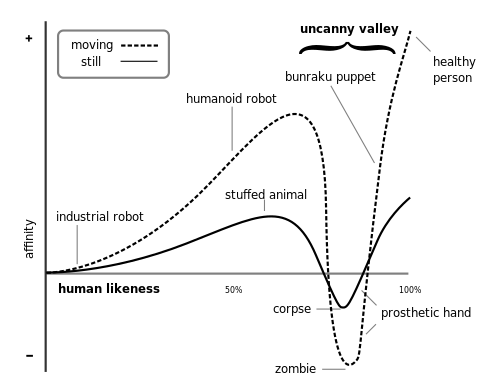 This idea is applied in multiple different ways to the non-player characters of Routine, in how they move, talk, and act. It’s used in several pieces of horror media to create monsters. Many theorize that the uncanny valley effect is a leftover evolutionary trait from when Neanderthals still existed, and we are subsequently feeling a disgust for them. Having children with them would result in genetic deformities, which hindered evolutionary progress. Many also hypothesize that it is a more core threat to the distinctiveness and identity of humanity, and that an instinctual reaction from a previous state of humanity is being carried forward. That is to say, we are viewing it from the perspective of the Neanderthals - we are seeing something that is not like us, and we are worried it will replace us.
IC Voices
The IC voices in the game are built using Microsoft SAM, an old voice synthesizer program from the 1980s developed by Microsoft to create artificial text-to-speech. For its time, the program was considered quite successful. It used existing computer hardware to give computers a voice. This program spun outwards from concepts in popular media, the most notable of early examples being HAL 9000 from 2001: A Space Odyssey. There is a distinct reference between the voices of synthesized speech in media and the methodologies used by real world examples in practice. The most popular commercial use of these voices is the BART train in the city of San Francisco, which announces train departures and arrivals over the loud speaker.
The voices of the IC bots follow this pattern both directly and thematically. When speaking, the lines they choose to say are pre-programmed and pre-rendered. When they repeat lines you can tell they are exactly the same, so they are not rendered in realtime. However, much of what they do say is intelligible, but only barely so. You have to pay attention to the noises they’re making with intent in order to understand. Other games use a similar methods to creep out the player, the most notable of which are the games by Airdorf, which combine graphics and gameplay similar to that of much older titles from the same era as Microsoft SAM, focusing on a late 90’s to early 2000’s aesthetic. The same can be said here, in which the bots who speak synthesize speech with the voice synthesizer programs available to them. As it appears that technology was roughly ~20 years ahead of its time in this world, it is clear that voice synthesizing in the 1980’s would have been the same. It is also worth noting that this timeline is one in which the Russians got to the moon first, which is implied heavily through the use of “Cosmonaut” as well as the languages of the axis powers of WW2 being used on the entrance room.
Adam Character Design & Animation
Adam’s design is long and thin, with several other appendages. In addition to this, he doesn’t have proper eye lids. His eyes are usually much larger, bulging out of his head. He’s completely hairless, and his sounds are consistently wet and spongey. His movements are long and lanky, and any creases in his skin are noticeable. By creating a character who almost resembles a human, they’ve managed to create an incredibly gross and unsettling creature. His movements also feel uncanny, because he has an impressive ability to remain still, and then suddenly move smoothly. In doing so, by using linear animation curves, they create an inhuman series of motions where the start and ends of actions are the slowest. He also poses like a child, standing in corners in comfortable positions as he tries to manipulate his lanky body. His limbs are almost too large for him, and the motions he performs are of those of someone who has never had an influence from other people around them. He grew up in a vacuum. His skin is also incredibly mono-color, grey, and smooth like a dolphin. The color of which resembles the lighting and rendering of the environment. The grey-green-yellow hues of the space are reflected in his skin. In many ways, the wetness of the surface of his skin matches the wetness of his movements. The team has done a great job making him feel almost like a reptile.
Suit Growths
The appearance of corpses in the game is never explicitly a body itself. We’re given several things which resemble the shape of a human being, but they’ve been completely deflated. The EL9 virus has entered their suits and simply drained the life from them. This immediately causes the player to heavily theorize about what happened to the person inside, as well as almost unconsentually attempt to imagine what the inside of the suit must look like. It’s another example of something that is close enough to a person, or a representation of a person, but we can’t properly place it. They’re not alive, but we can’t explicitly see that they’ve died. Their suits represent the dead husks of what they once were, literally and figuratively. I think this exists to serve the feeling of uncanny-ness in the way the people of the world feel. The only other person we see in the world is ourself at the very end of the game.
Recordings of People
At the start of the game the audio recordings of all the station’s members are fairly normal. As time goes on and they begin to become infected with symptoms, their speech patterns waiver. Their perspectives falter, and they begin to see the world through a complete unreal light. The way they describe their environments and their needs is still done with the voice of a person, but it doesn’t feel nearly as human. Especially once the Canal enters the fold do we begin to see the characters disembodied from their humanity. All needs point to the canal, that’s all that matters. It’s inhuman, and begins to creep the reader out.
Unreliable Narrators
The story of ROUTINE is told through the eyes of several characters, including the player character, who hallucinate consistently throughout the story. Those infected with the EL9 virus experience symptoms which discolor their perspectives, resulting in unreliable accounts throughout the story. Upon realizing this, the mystery is all the more intriguing to the player, and allows the story to play its cards openly, revealing things to the player that may or may not be true, making it difficult to discern what is truly going on. It’s a great tool to use, as it circumvents the common problem most mysteries have in which the secrets are revealed one by one to the audience, and eventually the lust and draw of them is lost. In this case, all the pieces are laid out in front of you, and it’s up to the player to determine how they fit together. The same can be said for how my personal favorite puzzles in most games are designed. By using unreliable narrators, the designers were able to consciously manipulate the player’s perception overtime with a firm hand.
Perspective Narrative
The story is delivered to use through a series of notes, emails, voice recordings, video recordings, and three direct encounters with NPCs. One with the IC Bot in the entrance to Union Plaza, another with the IC Bot HUGO, and lastly with Adam himself at the end of the game.
Other than that, the narrative is given to use through the eyes of those who have lived through the events at hand. The characters on the station each encounter the events at hand in the same order, but the main difference is how each of them handles the situation, approaches their solutions, and executes their plan overtime. It is mainly in the execution phase in which they succumb to the virus.
For example, John Cooper finds the virus in the cave, returns home and experiences minor symptoms, then quickly devolves into attempting to leave for the canal and dies because he is unable to.
In the story, the only character to have understood all of the points of the first half of the game is Kei Koyana. Kei uses her information at hand to construct a timeline in the security office. She correctly presumes that John Cooper was infected, and begins to lay out her plan to turn off the ASN. She was the one who requested the assistance of The Engineer. However, in the process of doing so, she allies herself with John and is subsequently likely killed by a Type-05 in the laundry room. Kei uses all of this information to leave pieces of information for the player to follow, acting as a critical guide. We never actually see Kei or find her body, we can only assume she has died.
Note To Self…
The story is able to be told in the slow, trickle-fed dramatic manor because the characters must leave information for themselves. As a player I was a bet too meta-conscious of this, and thought that someone was leaving me sticky notes as part of just gameplay. However, it was pointed out to me that the characters of the story leave notes for themselves due to the symptoms of the virus.
Consistent Narrative Delivery
One of the most important components of the game’s narrative is its ability to deliver it so consistently. Throughout player each environment is itself a non-linear space, the but overall structure of the game is. Narrative junctures are placed in safe locations which appear unsafe (see section on Unsafety for more) which ask the player to read, listen, or watch the narrative as it unfolds. Even though the environments are non-linear, because the narrative injections are placed at specific points in which puzzles and the story itself unfolds, the player will always experience those events. This also creates a varying timeline for each player, which has the benefit of a unique experience, breeding more interesting discussion between players.
By delivering the narrative at each choke point, the player will never miss them. This is why the story feels so consistently fed to the player, and properly done so, creates a semi-linear narrative which feels discovered by the player.
Determining Infection
A consistent strategy once you understand the unreliability of the narrators, is determining whether or not someone is infected. Throughout play you come to understand that the actors in the game are all acting with their own motivation, while their goals are different. Once you understand their goals, you can begin to make assumptions about their actions based on the information they receive. It is at this point one must determine if this specific actor is infected or not. The infection causes hallucinations, and therefore must be taken into account regardless of who the individual is. This dynamic between the player, character, and narrative builds a structure of untrustworthy information.
Atmosphere, Lighting, and Rendering
The environment of routine is incredibly well modeled and pines for hyper-realism of an idealized retro-futuristic view of technology, the world, and our future. Most of the lighting and rendering in the game works to push the feelings of the unknown, instability, degradation, and a space which is nearly familiar to something we know. In many ways, the choices made in art direction here are just as canny to the ones used to create the Uncanny Valley effect (see related section for more information). In short, the space almost looks like something we recognize, but doesn’t and the atmosphere, lighting, and rendering carry this tremendously.
Volumetric Fog & Lighting
Routine is filled with volumetric fog, pushing the idea that the space is now covered in dust. Every light interacts with volumetrics in some way, the most common of which is to show the parabola of the lights. In doing so, the environment is able to show an oldness and abandonment that would otherwise go unnoticed. It displays itself more prominently in areas which have spores, pollen, dust, or decay. Each area uses color, shape, and thickness of the fog to evoke and display a consistency of feel in how the area feels. This does a surprising amount of heavy-lifting for the feeling of age and discomfort in each area.
Union Plaza
Areas with low density fogs feel safe. Exposed areas with down-ward lighting make them feel comfortable. Long sight-lines of lit corridors make us feel in control. We can clearly see down the hallway, all of the environment around us at the station platform, and the IC bot itself who has an illuminated display. The volumes in this area are thin, such as in the top right corner of the screenshot. There is fog there, but it’s easily seen through. There is also a noticeable lack of fog in the hallway.  In the earlier stages of the crew quarters, the volumes act as a bright colored method of distinguishing silhouettes. This assists in creating visibility of sight-lines, and allows us to more easily see the Type-05 units we’re attempting to avoid as seen in the image below. In contrast to the next screenshot, we can see how much the volumetric lights matter in picking out our enemies, who have a surface material on them which does not pickup or refract indirect light, making them appear darker in the environment.
  Look closely at the image below. The Type-05 unit is standing directly in front of the player camera, but because the light behind him is not volumetric and quite dim, we can barely make out his character. Even so, he reflects nor refracts lighting.
  This is compared to a distinct impression of a silhouette we get in the crew quarters, from the faux-natural lighting.

The same areas gain more volumetric fog volumes, mono-coloration, and lose their site lines when they begin to feel unsafe, and the plot progresses. After the IC bot is destroyed, we see new volumes have emerged. In the reception area a spherical fog volume has been placed to create a cloud over it. The hallway also gains a new fog volume, and we have difficulty seeing through it to the end, blocking our sight-line and making it feel far more unsettling.  Spaces with even even a slightly higher density of fog begin to feel incredibly unsettling. In the screenshot below, we can see a contrasting feeling in the way the lighting and the volumetric fog oppose one another. If the volumetrics were off, we wouldn’t have such a tight-field of vision. The hallway to the left draws our eye because the fog is so thick it becomes a void. The lights inside of the pylons are so strong that they look almost blinding by comparison. This blue-tone feels out of place in an environment which is otherwise thrown astray, but by using it we can theorize the purpose of the environment before everything collapsed.
  Another powerful use of light is when a very bright light does not respond or interact with the fog. In this case we see a Type-05 which Kei had destroyed earlier in the story, and it is surrounded by brightly lit screens. Even though these screens emit light into the environment, there is not a volume of fog around them. This creates an unsettling contrast of information - our brains instantly and naturally say “This light isn’t natural.” This is in juxtaposition to the screenshot two below, which showcases how volumetric overhead lighting can create the illusion of safety, as it mimics natural sun-born lighting.
  I would also take note of how, with the lack of a fog volume, the rendering artist chose to create more prominent reflections nearby the subject to create a full-screen visible set-piece on screen to draw your eye.
 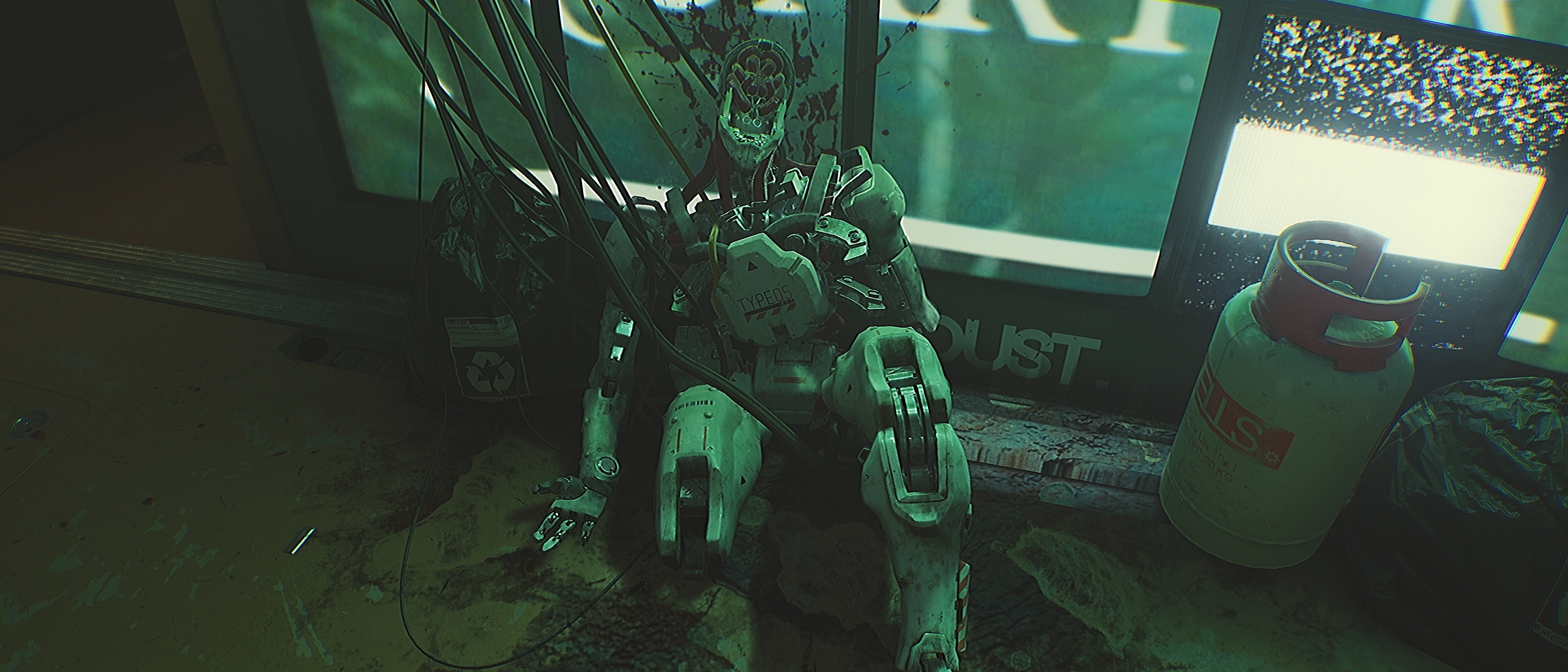 Below is an example of using bright, stark, clean lights combined with thin, buoyant fog volumes to create the illusion of natural light. Note how the volumes create god-rays moving in one contiguous direction, even though there are multiple light sources. This is how the natural lighting effect is achieved.

The Ward
The Ward features a distinctly different environment, with incredible broad and smooth volumes rather than the contained directional ones of Union Plaza.For example in the image below, we can see that the entire room is shrouded in a thick layer of fog, compared to the screenshot above in which there is a much higher amount of contrast between different points of the room.  Take note of how the fog volumes in this space are the things creating light, while there are no actual sources of light in the room. It creates an evocative and effective environment which guides your eyes throughout the space. It doesn’t feel artificial, but it definitely feels other-worldly.


Volumetric Voids
Aside from volumetric lights, the game also has the inverse positioned as volumetric voids. They suck light out of a space, running as a negative light. They suck all of the light out of a space, and create an artificial space of darkness. In the screenshot above, we can see an incredibly dark hallway to the left of the room. We can tell this is an artificially placed void because of the incorrect angle of the light entering the hallway. Rather than having the light bounce and refract down the hallway, the artificiality of the dark volume causes it to look significantly darker than it would otherwise. Above is another example of how darkened volumes can create a forced sense of contrast in a space. Just as before, light should be bouncing into that room, and due to the dark void inside of it, it’s unable to.
This effect of voids builds such a strong sense of the unknown that we can’t help but keep our eyes on it constantly. It’s difficult not to give it our full attention. Whenever the player is in a space and has to turn their back to a darkened hallway, especially a void, they feel a sense of unsafety that they can’t shake.  Another example of the artificial darkness is when you have to move through the darkened staircase to get to the basement security terminal. In this case, you only have the light of your helmet to illuminate your path. This kind of darkness is unusual for the remainder of the game, and happens infrequently. Of all the sections of the game, this is longest, darkest section the player has to walk through. Notice how even though the room immediately after this one is lit, the player cannot see the end of the darkness.
Selective Long Range Lighting
The game uses close and far forms of light to present its spaces to us. When we can see very far, the light is static and airless. When we can only see nearby, the air appears to be filled entirely with dust, causing volumetric fog to fill the room.  The moon’s surface allows us to see so far, it’s unsettling. There’s a sense of agoraphobia in any moment where we can see for long distances in the game. Rarely does this ever happen, and when it does, there’s nearly always a reason for it. Seeing this at the start of the game doesn’t mean much, but as we become more and more familiar with the game’s foggy atmosphere, being in areas where we can see for miles becomes unpleasant.
  After spending hours cooped up in small rooms, large outdoor spaces begin to elicit agoraphobia in the player. This is what makes the moon sections so awkward - the player doesn’t want to be attacked in the midst of feeling so spread out in the open.
Environment
The environment of ROUTINE is built in a way that a space station would be, but there are elements which are smoothed over to make the game more enjoyable, or scarier. Here I’ll move through each point and discuss ideas and pieces I’ve noticed from throughout the game.
Logic of the Terminals
Terminals in the environment are connected to their own small network. They’re not connected to the internet as far as we can tell. All of them interact with one another and the ASN. This comes into play as we learn more and more about how the ASN thinks, how it identifies illnesses and contaminates, and how it searches files for evidence. Characters also use the terminals for the things they need to do, which allows the player in-turn to do similar things as well.
Terminals and their Environment
The concept of this idea is simple. When CDs were popular every computer had a button to open/close a CD tray. After years of not using one, I inadvertently clicked a digital button on the screen to open the CD tray, and got a surprise when the tray actually did open. It made me realize how far our technology has moved away from physical interactions. In ROUTINE, the terminals do the opposite. You use them for doors, they manipulate puzzles, and they control some of the robots (you can summon the Union Plaza IC, for example). It’s this strange effect in which the digital connects to the physical which has been lost since the early 2000’s. I think they captured it well here.
Lighting over the course of the game
At the beginning of the game the majority of space are lit with several different kinds of color and light. There are light and dark sections, and the majority of the time the contrast is high, and there is very little clutter or fog on the screen. The lighting is also reactive to the player. There are power lines that spark when you touch them, lights in rooms will flicker if you’re nearby, the world jolts to life when you approach.
As you move towards the second half of the game, the lighting becomes far more bleak. The contrast lowers. There’s far less saturation. Everything begins to feel like a similar blend of beige-green-grey. The lighting also stops reacting to the player, save for the lights above each of the doors. Previously where walking into a space triggered an advertisement to play, spaces are now static. The world is dead, the lighting is bleak, and it doesn’t care if you’re nearby.
Volumetric Volumes to Leverage the Abyss Effect
In this case there is a stark environmental choice to use dark volumes of void to press the abyss effect. This can be seen throughout the game, and creates spaces in which the player is unable to see the end of several spaces, even if they are in the dark. In the crew quarters, there is actually an entire room that is completely dark. You’re unable to access any of the doors, making it entirely a mystery until later in the game. I attempted to fumble around in the dark to see what I could find, but I was unable to make my way. For more on this, see the sections Volumetric Voids and Abyss Effect, respectively.  I’ve already discussed these in detail in other areas, so I’ll save the extra description.
Acknowledgement of the Player Overtime
At the start of the game, things react to you with an incredibly high level of frequency. The lights in the starting area flicker, the terminals nearby play music when you appear, streamers hang from the ceiling and wave whenever you walk by. Metal detectors at the tram stations buzz, the tram itself opens the door for you. The IC unit at the entrance to the plaza mall springs to life without you realizing it. Doors automatically shut when the ASN doesn’t want you there. The Type-05 robots react to you the moment they notice you’re nearby. Exposed power lines spark and glitter when you touch them. Store signs turn on when you’re nearby them. The IC minis begin to make noise when you’re near. HUGO speaks up when you turn on the system. Instructional slides sputter on when you’re near. Seemingly dead Type-05 bots attempt to regain their lost spark of life by lunging at you, or falling over whenever you’re nearby. All of these elements acknowledge your existence. The game says you’re a part of it.
In the latter half of the game, nothing cares about you. Videos play on their own, on endless loops. The machines of The Ward do their functional tasks whenever they want. Nothing in the environment reacts to you, nothing other than Adam. Everything is quiet, desolate, and forgotten. This is a space for you and Adam to share. Any noise comes from one of you. Any movement is one of you. You are alone here, and nothing is going to change unless you change it.  Example of an environmental object which responds to your movements. We don’t see this as much later on.
  Being trapped in a closed off space that doesn’t change on its own at all for hours, and then immediately hearing the cries of Adam builds a level of tension that comes rarely in any piece of media.
Non-Linear Design
As mentioned in the section about consistent narrative delivery, the non-linear structure of the levels themselves is combined with a linear story structure. This allows for each set piece to be assuredly discovered, but doesn’t bog down the process of play with unnecessary elements. In doing so, they’ve created a game which changes slowly overtime, and whenever those changes happen, they are significant. This almost faux-non-linear design makes each discovery feel just as important and self-made as the last. By making the levels non-linear, the player is allowed to make mistakes and explore to find what they are looking for.
Claustrophobia
ROUTINE is a game where tight spaces are tight. You are a person trapped in a labyrinth of corridors which, more often than not, are barely wider than your own frame. This is done through thin hallways you must traverse, as well as several crawl-spaces the player must move through in order to progress. 
 Being in these spaces immediately evokes a sense of being threatened. It’s a natural human response to being in a tight space.
Missed Opportunity: Chased through a Tight Space
There’s a distinctly missed opportunity for the player to be chased through a crawlspace. This is a bit unfortunate, as it’s ironically one of the spaces in which the player begins to feel safe. Having a faux-Adam scurry through a crawlspace would be a fantastic method of creating a false sense of insecurity or unsafety in the player.
Agoraphobia of Space
In contrast to the tight spaces of the interior of the lunar base, the player is subjected to the wide open areas of space. These cause stress in the player whenever they move through them, as the contrast of a giant large space means there’s very few places to move to or hide. It also means something could approach from any angle, regardless of the lack of evidence that any of the known enemies could appear in a space without an atmosphere.
Religious Iconography of the Ward
There’s much more to be said about the Ward than I can fit here, but safe to say there is an obvious correlation between its design and religious iconography. The tree is the tree of life, Eve dies by eating an apple, making The Ward the garden of Eden. This parallels with the birthing symbolism; Rebirth, the canal, the water breaking, the prongs, the ultra sound, ongoing. All of this appears to have been done intentionally by the members of the lunar base team, under the guise of the EL9 virus. The game’s designers made the deliberate choice to make the facilities in this way, and built an entire small game world around a series of single-ideological ideas. It works perfectly to keep the player engrossed in the plot.
Sound Design
The sound design of ROUTINE is just as important as the visual design. Turning the sound of the game off ends up making it an entirely different experience. It’s no where near as frightening or engaging. The audio of the game activates a fight-or-flight mechanism in our brains, building a stronger web of immersion as we engage with the game.
Reverb & Bounce Zones
Each space in the game pays special attention to the reverb zones of that space. It’s an important element of how the game presents auditory components. Noise in Routine is space-dependent, which means it not only echoes differently, but bounces off of walls. You’ll hear things nearby if they can reach you, but you won’t hear something directly behind a wall. There are exceptions to this occasionally, but generally speaking audio acts as it should within the spaces it’s in.
Filtered Audio
All of the audio in ROUTINE has some sort of filter placed on it, as the player is wearing a space suit and can’t hear the environment properly. This is done to evoke a sense of realism, but in many cases the eerie quiet lends itself more to the din darkness than anything else. The filter makes it disturbing, because we need to pay attention to it in order to progress.
Room Tone Cuts
Whenever the game wants to evoke an even stronger sense of crisis, it’ll slowly accumulate a white-noise room tone overtime, then cut it out. This creates a fake sense of intense silence, as the player’s brain becomes used to the consistency of the room tone in the scene. Removing the room tone creates a sub-conscious moment of crisis, as the environment now feels even more hostile.
Wetness of Adam
Adam’s movements are entirely wet, slimy, and sticky. His footsteps are the primary source of this wetness. You can truly feel the cold wetness of his feet as he walks along the concrete surfaces of The Ward. His gurgles and squelches are also just as disgusting. You can hear all of these noises inside and through walls. It helps to make him feel even creepier and stranger.
Moon’s Surface
All of the sounds on the moon’s surface are run through a high-pass filter, so it sounds as if every noise outside your helmet is only being heard as a vibration in your suit. This is accurate to how sound on the moon should feel. The only other sound you hear in these moments is your own breathing inside of the helmet.
Monsters
Type-05
The Type-05 bots serve as the eyes and physical ends of the ASN. They patrol the area looking for those infected with the EL9 virus. In some cases they attack the IC bots, but it is unclear why they are doing so. (I have personal theories about the IC bots getting infected)
Operating Type-05
Operating Type-05 units patrol the environment of the Union Plaza space station. They are functionally linked to the ASN, but we know they’re not live-linked. They operate with a set of logical parameters to patrol and protect the space.
Logical Robotic Behaviors
Their behavioral pattern is simple: Patrol, Stand. In between those behaviors if they sense a player, they pursue. If they lose track of the player, they scan their last known location in an attempt to find them. They will then attempt to pursue you by throwing you, then killing you if you don’t manage to get away.
Cinematic Positioning
Throughout the entirety of the first half of the game, the Type-05 units stand menacingly in hallways. This is done for atmospheric effect, and to make the player feel unsafe regardless of the circumstances,
Faux Type-05
There are many cases in which there are faux Type-05 units strewn about the environment that have no AI. These are either ones that have been killed in the game space, or ones that have been deactivated.
Dead Type-05 Units
We see dead Type-05 Units throughout the environment. From a design perspective, this is likely so that we can get a good look at them. These are placed throughout the game to seemingly invoke discomfort in the player.
Undead Type-05 Units
Throughout the first half of the game, there are two instances which I experienced in which a Type-05 unit would “turn on” after I had already passed it and determined it was offline. First is in the briefing room for the C.A.T. gun module, second is in the basement room. Both of these units serve as “undead” as they can come alive, but not fully hurt you. However, if you give the second one enough time, it does end up turning into a fully functional Type-05 unit with an AI brain.
Adam
Adam is the monster in the second half of the game. He exhibits a series of behaviours that are significantly more complex than the Type-05 units. In many ways he has different objectives than the player. He thinks and maneuvers through the space at a different pace. He wants to observe you in some cases. If lore is to be believed, Adam has been locked up in The Ward from 1979 until 1999, which would make him 20 years old.
Adam can teleport, go invisible, make noise, move slowly, and move quickly. He cannot suddenly change speed the way that he Type-05 bots can, but his movements and motions are significantly different.
Real Adam
In this case, “Real” refers to an instance in which the player encounters Adam and his AI is functioning. This means he can be stunned, and he’ll try to kill you. He’ll wander, make noise, listen for you, and attempt to get to you if he can.
Adam’s AI & How he acts
Adam’s AI, as far as I can tell, responds directly to a series of triggers that the player can activate. These can be things like, activating a terminal, opening a door, or standing in a specific spot. I believe that Adam has been programmed to be an actor in the space, not necessarily to try and kill you, but to try and scare you. This is what I mean by “act” in this case. If you actually sprint right up to him suddenly and quickly, he won’t know what to do, because he isn’t designed to have that happen to him. In most of the cases in which I did do this, his model clipped, his animations suddenly changed, and he would either teleport away, or kill me after about 10 to 15 seconds of standing there.
Scripted Interaction Entry Points
If we consider the environment to be a staged on, where Adam is an actor responding to improvised queues, this begins to make more sense. For instance, if a player is hiding underneath a table after being chased by him, he will bend down slowly to check underneath the table. If the player is at the end of a long hallway, Adam will appear at the other end, and start moving slowly towards them. If there are particularly awkward corridors, Adam will be invisible, and as he moves closer to the player he will knock over objects and move hanging plastic streamers to make the player aware of his presence. These are not necessarily scripted events, but by putting Adam in specific locations and setting him loose, the game is able to create calculated and emergent moments of fear.
Fake Adam
Fake Adam is what I’m calling any instance in which Adam is seen in the world, but his AI is disabled. These are mostly shots of him being still in the world, observing you. It’s only after you get close enough to him that he realizes you are there, and a Real Adam enters the level. In many cases, this happens after Adam teleports somewhere else. 


Faux Adam
These are instances in which Adam appears in the environment, but there is no chance of him ever actually being there. These are functionally models with animations played based on player interaction triggers.
There are very few of these moments in the game, but one of the most commonly seen ones is a jumpscare in the first section of The Ward, where Adam pops up as you’re trying to get the keycard on the table. 
The Unknown
ROUTINE is filled with what I’ll describe as Unknowns. This is ultimately a game of crawling discovery, as you slowly shift the sands of its bed around to uncover glimmering pieces in the sand. It’s infrastructure is even foreign, with the door to the tram being the first thing that reacts to your presence. Both myself and Sydney got a start from it. Unknowns in this game come in Small and Large forms, with the small ones being “oh, that’s how this works in this world” such as the Tram, and the Large ones being broader components of the opposite, such as “Wow, that’s how this world works?” Together, they create a consistent trickle of the Unknown, allowing them to discover the game world overtime, which ultimately reinforces a Mysterious environment. This feeling of the Unknown is promoted by the Atmosphere and Environment Design.
In short, an Unknown in this context is anything you can understand through interaction.
Unknowns ultimately serve as an introduction to the world that is already built through small trickling interactions. The world of ROUTINE is obviously very large and complex. By giving these components to the player through a constant drip-feed, the world design can shine through its components.
Small Unknowns
As discussed above, the small unknowns of the world are tiny non-committal components, all of which are Persistent in the game world. These help to reinforce the feeling of Mystery in the game world. These need to be paced properly, and most if not all of them are non-threatening. The Tram Door is the first example, but others are the way that hanging exposed wiring interacts with the player. If you walk to close to it, it sparks. Same can be said for the metal-detectors in the tram areas, if you walk between them, they detect you and make a completely strange and other-worldly noise. Another prime example is how the small IC robot at the entrance to the mall reacts to you. He is non-threatening, but still a new component of the world that you must come to understand through engagement.
There are loads of small unknowns throughout the game, I will list a few of the most prominent examples so it’s clear what I’m talking about.
IC Bots as Small Unknowns
Most small unknowns are circumstantial and accidental, and many riff off of one another. Watching as the environment almost doesn’t work around you is quite interesting. An example of these riffs is the large IC bots and how they interact with you. They have a series of voice lines that they use throughout the game, and they themselves as characters are quite lovable. When the one at the mall dies, it’s sad. You quickly learn that they’re there to help you. And in the context of the world that’s exactly what they’re doing. Each interaction and mention of with them is small, but seeing them do things in the world is intriguing because it is so unlike everything else.
The first living one the player encounters is in the mall, and it’s friendly to you. It’s genuinely trying to be helpful, and wants to help you get there. It talks about how the mall is the coolest. It makes fun of you for not being able to sign in. When the elevator isn’t working, it guides you to the ladder and says “I love helping people who have no idea what they’re doing.” The character is completely unknown to you and an outlier in an otherwise frightening and scarce environment.
Doors as Small Unknowns
As the game progresses doors become more and more meaningful to the experience. The first door of the Tram is simple - walk up and it opens. Immediately after, doors are operated by connected pads, which you have to click using a terminal interface. Later on doors begin to have more rules. The door control systems of the second chapter have three active elements. First they have power, which is required to operate. They then have security, which leverages the newest module. Third are the airlocks and elevators, which serve as transitory spaces. Each of these kinds of doors has a new unknown that the player must understand. None of them are necessarily complex, but finding the next button to push or the terminal to tap is meaningful.
Furniture and Facilities as Small Unknowns
The game features an incredibly strong aesthetic, which also drives its presentation of furniture. As you progress from the Lunar Site to the Ward, the furniture undergoes a change from retro-futurism to an almost an environment rich in religious iconography. While there are still tables you can hide underneath, the furniture and facilities begin to serve a completely different purpose. Gathering spaces go from classrooms and shops to spaces of religious significance, such as the Tree in the Ward, or the reintegration hallway at the beginning of the player’s experience in the Ward. I’ll talk about this transition from Function to Form in the environment section, but as an unknown it works quite well. The notes, fonts on terminals, faux-natural lighting, and even the nearly pew-like seats create moments of discovery as you realize what this place is for. Coming across these unknowns is meaningful. Even the projectors in the first section begin to provoke a sense of wonder as you interact with them in the classrooms.
Large Unknowns
In contrast to the small unknowns, large unknowns change how the world works. They are broad spanning elements of the game, narrative, or environment which contribute largely to how the entire world functions. Some examples of the Large Unknowns are the ASN, the EL9 plant-life, Adam & Eve, and the station itself. Large unknowns serve to be huge discoveries that mean loads to the player and the story. They each serve a dramatic purpose in the space of the game. All of the robots connected to the ASN are a function of it as an Unknown, and you interact with it overtime to understand them. They’re large spanning systems which are largely unknown to the player.
The ASN as a Large Unknown
Throughout the first half of the game the player is essentially uncovering the systems and functions of the automated security network. Functionally this serves as one dramatically large unknown, with each of the robots, cameras, and environmental sensors reacting to your presence. You must learn how each of these components work as the Unknown tries to kill you. The Type-05 robots react to things in space, the way the sensors see you causes doors to close and block your exit. Turning off the ASN is a huge moment with its own puzzles and rules, and even in doing so, you begin to see its internal functions. Watching it die is completely unexpected - the system feels dramatically alive.
The Ward as an Unknown
The Ward itself feels largely more like an unknown than any other portion of the game. As a place, many components of the game have a real-world counterpart. The Mall, the Security Office, the classrooms, arrivals, etc. They all have elements that we, the player, can easily point to and say “I know what this is.” A Ward in reality is a space for healing, typically something like a burn ward. In this context it is an environment for religious cleansing and imaging. As you uncover its purpose, and how it has been malformed to serve the Canal, the purpose of the Ward is becomes clear. It shows how a large and unconventional space can become unknown within the context of so many other pre-known things.
Unraveling a Mystery
Unknowns make it so that YOU feel like you’re the one unraveling the mystery, even if it is linear. It is the non-linearity of these discoveries that makes the mystery feel so natural to discover. The game takes a series of elements, presents them to you, and says “figure it out.” Which brings us to the next section…
Puzzle Design
Puzzle design in this game follows a series of basic forms, none of which are too complex or unique to the world or gameplay.
“Here’s everything, figure it out” Rule
One of my favorite kinds of puzzles in games is one in which the player is given all of the pieces, and it’s up to them to figure out how they fit together. Much like a literal jigsaw puzzle, but with abstract pieces that serve different function in the grander scheme. The best example of this is the perspective puzzle in The Ward, in which the player must go to specific locations and scan them with the C.A.T. module so that they can decipher the cipher left for them to open the door. All of the pieces are there, it’s just up to the player to figure them out. Just like the narrative’s structure.
Puzzle-In-Crisis
Many, if not all of the puzzles in this game, follow a feeling of having to think while under duress or in danger. As I’ve engaged more with the horror games genre, I’ve come to learn this is a great rule of thumb. If you have to think while you’re in a scary situation, it’s far more difficult. Having to do so while being genuinely terrified is what makes Routine so engaging.
Playful Puzzles
Throughout games my favorite puzzle design is the Playful Toy. It always makes me fond when a designer clearly spent a lot of time making a toy, and then turned that toy into a puzzle. In ROUTINE, we see this often with the different C.A.T. modules, but it’s also seen with the way the security camera allows us to see the sticky notes on the screen. Many of the best puzzles in the game come from things which clearly began as fun toys and were then re-framed as puzzle pieces.
Physicality of Interaction
We interact with the world in a few ways. Outside of the elevator buttons, there are barely any other things we do. Usually we just look at a screen and click, but it is the C.A.T. itself which allows us to interact with the world even more.
The C.A.T.
It’s a tool, akin to the one you receive in Deadspace. Both games feature a tool used as some sort of weapon, as well as diegetic UI that properly displays the information in the game space. The novelty of the C.A.T.’s screen is never lost on me. The developers did a great job of making it feel like a piece of technology from the future of the 80’s that made its way into the game.
Perception
The tool allows us to see the world in different ways. This is by far the most exciting prospect of the C.A.T. from a design perspective. Being able to scan environments to see finger prints or paint left behind, as well as use the security mode to scan and see Adam in infra-red. There’s a real reason to use its small screen as you play the game.
Modules & Multi-Functionality
As you progress through the game you get a series of other modules, which allow you to use the C.A.T. in new ways. It’s an interesting process as you gain more and more things on your tool. The game slowly introduces them throughout the process of play, so that you’re forced to learn new things as time goes on. You eventually leave your old modules behind. For instance, the player does not use the normal mode nor the shock functionality when encountering Adam at all. Even though there are puzzles later in the game which could be solved using the Ultra-view module to scan for finger prints, the tool does not pick them up, resulting in a conflict of consistency in the tool’s use. However, it also doesn’t pickup any finger prints on any terminals aside from the ones you’re supposed to use it for. This could be a flaw in the design of the mechanic, or a conscious choice made by the designers to prevent it from getting too confusing or misleading.
False Sense of Unsafety & Insecurity
The game is constantly presenting the player with a sense of Unsafety or Insecurity. There are new things around every corner that make you feel lost or unfounded. You’re almost always alone, and when you’re suddenly not it’s terrifying. And so, throughout the game, you are consistently fed more and more information to make you feel like you’re unsafe. Even though you are almost always completely fine.
Adam Programmed to Never Interrupt the Narrative
As you are moving through The Ward, you discover countless tapes and videos you need to watch. In all of these cases, I was consistently worried that Adam would sneak up behind me and kill me. This never happened and I believe it is by design. Having the story be interrupted by an encounter would damage its flow, and since the narrative needs to be reliable and consistent within a non-linear level, there are restrictions on Adam.
From my findings, there are some things Adam will not do:
- Adam will never come near when watching a video or playing a cassette
- Adam will not interrupt you while you are reading an email page or diary
- There are several rooms where Adam cannot enter. I was surprised he could not enter Echography, but it makes sense
- Adam will only make noises if you are using a terminal, and then a faux or fake Adam will appear
Adam will never truly interrupt your process of engaging with the game’s narrative. He will only float around you and avoid you completely to continue to scare you as you play. This pushes the feeling of insecurity, even when his AI is not active in the level. For example, in the section with the infamous key-card jump-scare, Adam is not active. He doesn’t appear in the Ward until after you turn on the servers. So for almost an hour of snooping around, the player is navigating a completely safe space, but it certainly doesn’t feel that way.
Scripted Faux Adam Events in Safe Places
As mentioned above, Adam has a series of scripted Faux events in which he appears but is not a threat to the player. These are mostly jump-scares. There is one instance at the very end of chapter 06 in which you must use the elevator, and if you make a run for it, Adam will chase you. In my instance I ran straight for the elevator, turned, pushed the Up button, and saw him right behind me as I was exiting. I believe this was a scripted faux event in which Adam appears but does not present a real threat to the player (unless the scripted event calls for it). Even though I was completely safe, seeing the monster who had been hunting me for the past few hours was terrifying, because he seemingly appeared out of thin air.
In Conclusion
Routine has a terrifying environment. Everything is lurking in the dark. It’s hyper realistic and pushes the abyss on you. It’s never clear when you are safe. The technology is clunky and awkward, making it stressful to use. The environment is claustrophobic or agoraphobic, and there is no in-between. You must solve puzzles while you’re in this terrifying space, or die trying.